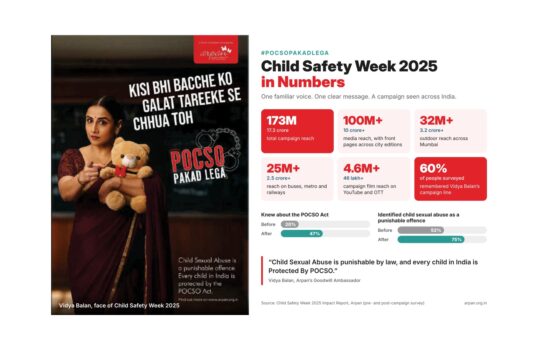
As NGO ARPAN’s Goodwill Ambassador, Vidya Balan is the face and voice of its Child Safety Week campaign, #RukJaoVarnaPOCSOPakadLega. She speaks about breaking the silence around child sexual abuse and building a culture where children are heard and perpetrators are held accountable.

Friday November 13, 2026 , 7 min Read
In Kahaani 2, Vidya Balan played Durga Rani Singh, a survivor of child sexual abuse who fights to stop it from happening to another child. While researching for the film, the actor met Pooja Taparia, the founder and CEO of ARPAN, a non-profit working to eliminate child sexual abuse (CSA) in India.
“Pooja helped me understand the scope and scale of child sexual abuse and how pervasive it is,” Vidya tells SocialStory.

After the film was released, something unexpected followed. People she had known for years began sharing their stories.
“These were people I never knew could have been through such experiences. On the face of it, you can’t tell what someone has been through. I think they felt I could understand what had happened to them and that they were not at fault,” Vidya says.
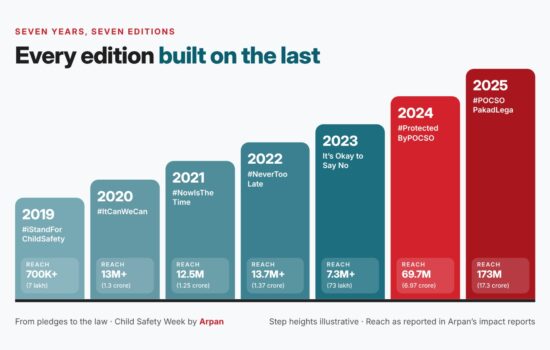
In 2018, ARPAN invited Vidya to be its Goodwill Ambassador, and she has been a part of Child Safety Week since then. This year, she returns as the face and voice of the 8th edition of Child Safety Week (CSW), held annually from November 14 to 20, in partnership with the Mumbai Metropolitan Region Development Authority (MMRDA) and Maha Mumbai Metro Operation Corporation Ltd (MMMOCL).
Through this year’s campaign, #RukJaoVarnaPOCSOPakadLega, ARPAN aims to take the conversation on child sexual abuse beyond awareness to recognition and accountability.
The campaign brings the provisions of the POCSO Act into everyday public spaces, encouraging parents, caregivers, educators and communities to identify abusive behaviour, including acts often dismissed as harmless, and understand their legal implications. It also sends a clear message to perpetrators that child sexual abuse is a crime and will attract legal consequences.
The Protection of Children from Sexual Offences (POCSO) Act, 2012 was enacted by the Government of India to safeguard children from sexual abuse and other sexual offences. Extending the campaign’s reach beyond the metro network, #RukJaoVarnaPOCSOPakadLega will feature across 30 buses with external branding and 1900+ buses with internal branding across Mumbai, Thane, and Navi Mumbai; 5+ billboards, 20+ digital signages along the Western Express Highway and 100+ banners across schools, bringing the conversation on child safety into everyday public spaces. It will be amplified across digital bus shelters at select locations across Mumbai; digital screens at Western Railway stations; on billboards and digital signage along the Western Express Highway and 1700+ digital screens in residential societies.
According to the National Crime Records Bureau (NCRB) Data for 2024, 1,87,702 cases of crimes against children were registered, including 69,191 cases under the Protection of Children from Sexual Offences (POCSO) Act.
In a written reply to an unstarred question in the Rajya Sabha on July 23, 2026, Minister of State (Independent Charge) for Law and Justice Arjun Ram Meghwal said that 398 exclusive POCSO courts were functional across 29 States and Union Territories as of April 30, 2026. He added that 775 Fast Track Special Courts, including these exclusive POCSO courts, had registered 1,43,936 cases in 2025, disposed of 66,500 cases and had 2,45,579 cases pending as of December 31, 2025.
Not just rape and inappropriate touch
Vidya points out that when people hear of POCSO, they think only of molestation and rape.
“The law covers all forms of Child Sexual Abuse and calls out each of them as offences. Inappropriate touching, looking with sexual intent, making sexual remarks or gestures towards a child, using a child to create sexual images and viewing, saving or sharing such material, known as Child Sexual Exploitation and Abuse Material (CSEAM), is punishable under POCSO. So abuse doesn’t have to be always physical for it to count, and for the law to step in,” she says.
“Let there be no ambiguity: all of this constitutes child sexual abuse. I don’t think there’s any scope left for offenders to hide,” she adds.
ARPAN sees the campaign as a response to that gap.
“While awareness around child sexual abuse is growing, many still fail to recognise acts that constitute offences under the POCSO Act. Through this year’s Child Safety Week, we want to make these provisions easier to understand and help people identify and call out abuse rather than overlook it. Protecting children is a collective responsibility, and every adult has a role to play,” Pooja says.
“Someone the child trusts and knows”
Child sexual abuse often takes place in familiar surroundings, with perpetrators being people children know and trust.
According to NCRB data, 97% of the accused in crimes/rape cases involving minors (children below 18 years) are known to the victim. Also, in India, one of the biggest barriers to addressing abuse is the tendency to link it to family honour.
“We have to stop linking child sexual abuse with family honour. When we link them, the child gets blamed wrongly, and the family gets shamed. All these fears of what will happen if other people in the family stop talking, and losing important relationships come up. But these are individual acts, and they have to be called out for what they are,” Vidya notes.
What adults can do
The onus, she emphasises, lies with the adults in the family. It begins by teaching children about “good touch and bad touch”. While schools are educating children about child sexual abuse, the adults in the family need to foster a feeling of trust.
“Children speak up when they know that disclosing will make things better, not worse. It is our responsibility as adults to make sure it does. And when communities stand by those families, reporting stops being an act of courage and becomes the expected thing to do,” she elaborates.
She reiterates that when parents have the knowledge and skills, they can identify how abusers use grooming to gain access to children and win the family’s trust. They can then recognise warning signs early, rather than mistaking abusive behaviour for affection, care or attention. With this understanding, parents can stop trusting someone just because they are family and build the confidence to put child safety first.
“I want parents and teachers to start open conversations on the issue with other adults, and to call out inappropriate behaviour around a child, even when it comes from someone they know well. I want adults to give children age-appropriate information on personal safety, and to respond with belief and support when a child shares something. And I want every offender to hear the message clearly: #RukJaoVarnaPOCSOPakadLega,” she adds.
Despite increased awareness, advocacy around child sexual abuse can be challenging. Vidya recalls an instance when she wanted to highlight the issue on a television show. She was told the channel’s policy did not allow discussions around the subject.
However, she sees the growing openness on social media as a positive development.
“The great thing today is that people can talk openly about these things on social media, and I find that very heartening. There are so many accounts of people for whom child sexual abuse comes up as part of their story, even if they aren’t campaigning on this cause. All of this will help,” she says.
Vidya hopes this campaign will warn offenders that there is no place to hide anymore.
“#RukJaoVarnaPOCSOPakadLega aims to help people recognise these behaviours as crimes and punishable, and tell every offender clearly that they will be held accountable,” she concludes.